

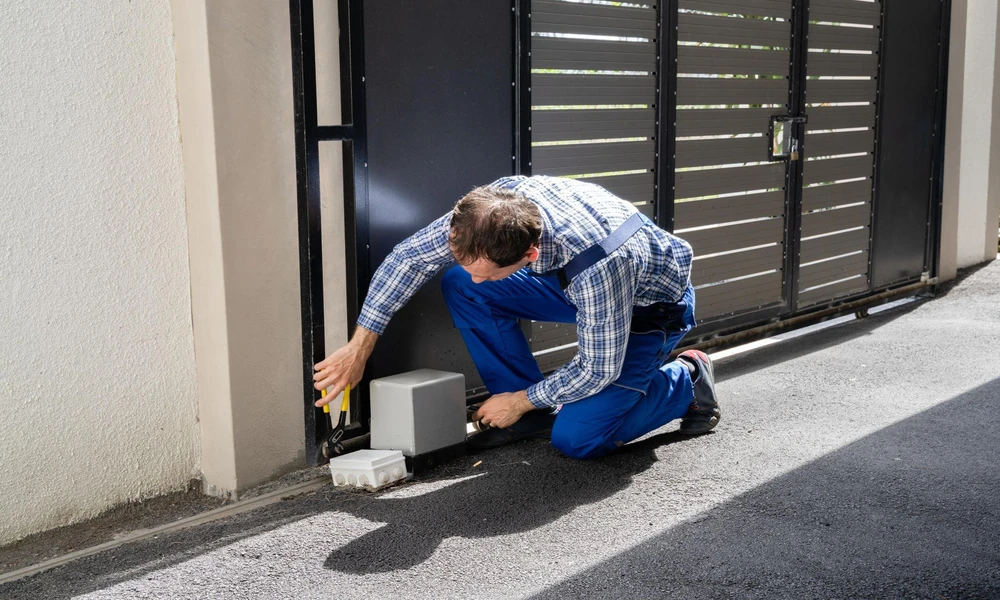
Gate motors rarely fail without warning. They slow down, make unfamiliar noises, or start needing two attempts at something they used to do once, and homeowners adapt to each change without registering it as a developing fault. By the time the motor stops entirely, it has usually been signalling for months, and the repair at that point is considerably more expensive than it would have been earlier. Five signs indicate that an electric gate motor in Singapore needs attention rather than continued tolerance.
1. The Gate Moves Noticeably Slower Than It Used To
Speed is the clearest early indicator. A motor working harder to achieve the same movement is either straining against increased resistance or losing capability itself.
The common causes are mechanical rather than electrical: debris in the track, worn rollers, a gate that has shifted slightly out of alignment, or inadequate lubrication. Each makes the motor work harder, and sustained strain is what eventually burns one out.
Checking the track for obstruction and the rollers for wear is worth doing before assuming the motor is at fault, since a motor replaced without addressing the underlying resistance fails again on the same schedule.
2. Grinding, Clicking, or Any Noise That Is New
Gate mechanisms make a characteristic sound, and homeowners know it well enough to notice when it changes even if they cannot describe how.
Grinding usually indicates metal contacting something it should not, whether a worn roller, a bent track, or a failing bearing within the motor. Clicking during operation or at the start of travel can indicate a gear or drive problem. Either is worth investigating promptly, since continuing to operate through it generally accelerates the damage.
3. The Gate Stops Partway, Reverses, or Needs Repeated Attempts
Automated gates have safety features that stop or reverse travel when resistance is detected, and a gate stopping partway is frequently that system doing its job.
The question is what is causing the resistance. A sliding gate in Singapore that stops at the same point each time usually has a localised mechanical problem at that position, whether debris, a damaged track section, or a roller that binds, and identifying the location narrows the investigation considerably compared with assuming a general motor fault.
Where the stopping point varies, the cause is more likely in the motor or its control board.
4. Sensors Failing or Behaving Inconsistently
Safety sensors prevent the gate closing on a vehicle, a person, or a pet, and inconsistent operation is both an inconvenience and a safety matter.
Misalignment is a common cause, since sensors knocked slightly out of position no longer see each other reliably. Dirt on the lens, insects, and water ingress all produce intermittent faults. These are frequently straightforward to correct and should not be worked around by disabling the sensor, which removes the protection the system exists to provide.
5. The Remote Works Inconsistently or Only at Close Range
Where a remote that used to work from the road now requires being almost at the gate, the cause may be a weak battery, a failing receiver, or interference.
Replacing the battery first is sensible. Where that does not resolve it, a receiver or antenna problem is likely, and this is worth addressing since the alternative is getting out of the car.
Scheduling Servicing Rather Than Responding to Failure
Gate mechanisms benefit from periodic servicing: track cleaning, roller inspection, lubrication, alignment checking, sensor adjustment, and reviewing the motor itself.
Most premature motor failures trace back to mechanical resistance that a routine service would have caught and corrected cheaply. Homeowners who arrange servicing on a schedule rather than when something breaks generally get considerably more life from a motor, and the cost of a service visit is a fraction of a replacement. Any gate behaving erratically around vehicles or people warrants prompt attention rather than continued use.
Contact San Automation Gate to arrange an inspection of your gate’s motor, track, and safety sensors.
