

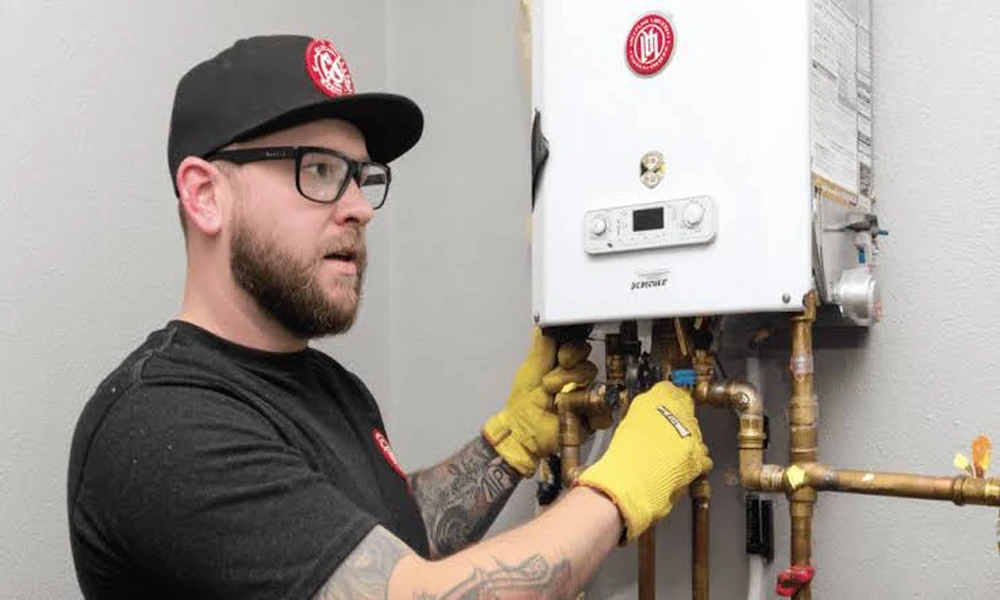
Switching from a tank water heater to a tankless unit is less like swapping one appliance for another and more like changing how a house makes hot water. A tank stores heat and spends it slowly. A tankless heater fires a large burner only when a tap opens. That one difference affects gas pipe sizing, venting, electrical needs, maintenance and how the system behaves on the coldest morning of the year, which is why the decision deserves more than a glance at the efficiency sticker.
For homeowners in Fishers, Carmel, Westfield and Noblesville, the most useful first step is a site check before any model is chosen, and that is how Fishers tankless water heaters installation begins with All-Pro Plumbing Services. The same licensed team handles the gas line work, the venting and the water softener that protects a tankless heat exchanger from hard water, so one visit can tell you whether your meter, pipe and wall layout are ready. Repairs on existing tankless units are covered too, with emergency calls answered day or night. Call 317-281-5510 and ask for a gas load and vent path review before you pick a unit.
Constant hot water against a winter flow ceiling
The promise of a tankless heater is that it never runs out. That holds true, but only within a flow limit. According to the U.S. Department of Energy, tankless water heaters typically deliver about 2 to 5 gallons per minute, with gas models producing more than electric ones.
The catch in central Indiana is how much the incoming water has to be heated. In summer, supply water arrives fairly mild. In January it arrives much colder, so the burner has to lift the temperature far more to reach a comfortable 120°F, and the gallons per minute it can deliver drop accordingly.
Tank heater in winter: same stored volume, slower recovery. Tankless heater in winter: unlimited duration, lower maximum flow.
A household that runs two showers and a dishwasher at once on a February morning needs a unit sized for that coldest temperature rise, not an average one. Undersize it and the trade is simple: you never run out, but you can’t run everything at once.
Lower energy use against a bigger retrofit
Tankless units skip the standby losses of a tank that keeps 40 or 50 gallons hot all day. The Energy Department estimates savings of roughly 24 to 34 percent for homes using around 41 gallons a day, shrinking to about 8 to 14 percent for heavy users near 86 gallons. So the smaller and more spread out your hot water use, the stronger the energy case.
The retrofit is where that savings gets tested. A standard 40 or 50 gallon gas tank usually has a burner rated somewhere around 40,000 BTU per hour. A whole home tankless unit can be rated close to 199,000.
Tank burner: roughly 40,000 BTU per hour on a half inch branch. Whole home tankless: up to about five times that, often needing a larger line and a meter check.
Many homes built in Hamilton County during the 1990s and 2000s growth years were piped for a furnace, a tank heater, a range and maybe a gas dryer. Adding a high demand appliance can mean upsizing the branch line, confirming the meter can carry the combined load, and in some cases asking the gas utility to evaluate the service.
Venting changes too. Most condensing tankless units vent through PVC out a side wall rather than up the old metal flue, which means a new wall penetration with required clearances from windows, doors and the ground, plus a condensate line and usually a neutralizer before it reaches a drain. In a Fishers winter, a side wall termination also has to sit where drifting snow will not block it. Because this involves gas piping and venting, it is permitted work and gets inspected.
A longer lifespan against hard water upkeep
The Energy Department puts most tankless lifespans at more than 20 years, compared with the 10 to 15 years a tank typically lasts. That longevity assumes the heat exchanger stays clean, and central Indiana water makes that a real chore. Citizens Energy Group reports a system average near 19 grains per gallon, which is very hard.
Tank in hard water: scale settles on the bottom and slowly lowers efficiency. Tankless in hard water: scale coats narrow passages inside the heat exchanger and can trigger error codes or shutdowns.
Most installers handle this with isolation valves that allow a yearly vinegar or descaler flush, along with either a whole house softener or an inline scale inhibitor. Many manufacturers also tie their warranty terms to water hardness, so treating the water protects both the unit and the coverage. Budget the treatment and the annual service into the lifetime math, or the 20 year advantage narrows.
Floor space and simplicity against power and price
A wall hung tankless heater frees the floor space a tank occupies, which matters in finished basements and tight utility rooms. It also removes the risk of a 50 gallon tank failing and flooding the space.
Tank: big footprint, works with no electricity if it has a standing pilot. Tankless: small footprint, needs a 120 volt outlet and goes cold when the power is out.
That last point matters in a region where spring storms and winter ice can knock out power. A Building America overview from the Energy Department also notes that tankless heaters usually need a minimum flow of around half a gallon per minute to fire, so a very low trickle at a bathroom faucet may stay lukewarm. Upfront cost is typically higher as well once the line, vent and condensate work are added to the unit price.
Weighing the four together
No single factor settles the question. A small household with spread out use, a gas line that already has capacity, and a clear path to a side wall vent will see the benefits of tankless quickly and pay little extra to get there. A large family with overlapping showers, a half inch branch line, very hard untreated water and a heater tucked in the middle of a finished basement faces a much longer payback. Most homes fall somewhere between, and the useful exercise is to rank which of these tradeoffs matters most in your house before comparing models, since the right answer depends far more on the building than on the brochure.
