

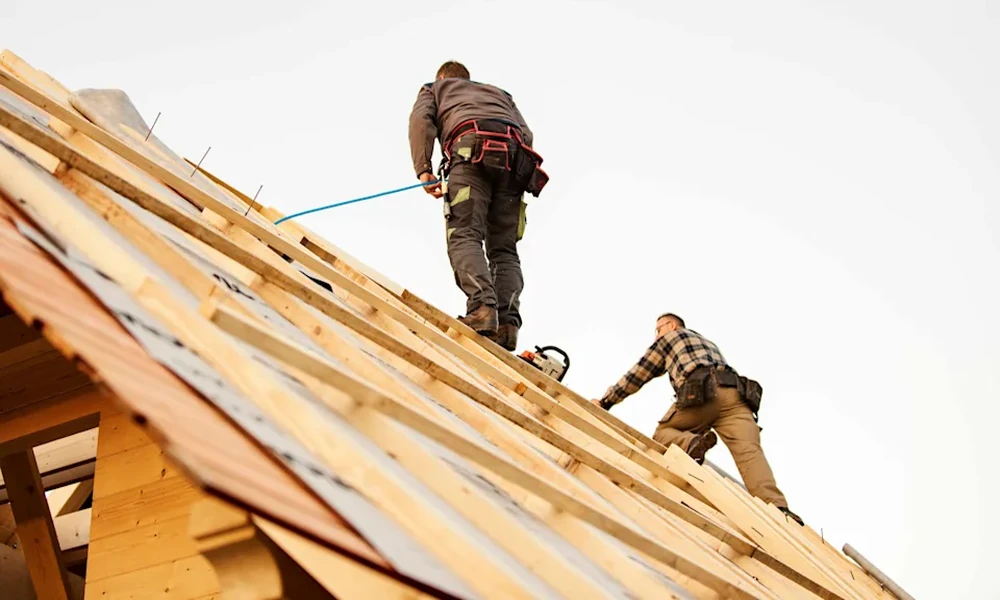
The first hour of a tear-off usually goes the way everyone expects. Then someone steps a little too close to the chimney and the plywood flexes under his boot like a wet sponge. In that moment the job stops being a roofing project and becomes a carpentry project, and the homeowner standing in the driveway rarely saw it coming.
That handoff between trades is where a lot of roof jobs succeed or come undone. A team like Best Carpenters Group that treats framing and woodwork as part of the same conversation as shingles tends to catch these surprises before they turn into change orders nobody understands. Whoever you hire, it helps to know what lives under your roof covering and why it matters more than the color of the shingles you picked.
Two Trades Meeting at the Same Nail Line
Think of a roof as two systems stacked together. The top system sheds water. That means shingles or metal panels, underlayment, flashing at walls and chimneys, and the drip edge along the eaves. The bottom system holds everything up. That means rafters or trusses, the deck of plywood, OSB or old boards nailed across them, and the trim at the edges called fascia and soffit.
Roofers are specialists in the top system. The bottom system belongs to carpentry, and on many crews it gets treated as an afterthought, handled only when rot is too obvious to ignore. The trouble is that a perfect shingle job fastened into weak wood is only as good as the wood. Nails need something solid to bite, and the deck has to stay flat for shingles to seal properly.
How Wood Starts Failing Long Before a Leak Shows
Most roof rot is slow. Water does not need to pour through a ceiling to ruin sheathing. It only needs to visit the same spot over and over. A few common sources show up again and again.
Flashing that has lifted around a chimney or skylight lets small amounts of water run down the deck every storm, soaking a strip of plywood that never fully dries. Attic moisture is another culprit, especially when bathroom fans dump steamy air into the attic instead of outside, or when soffit vents have been painted shut or blocked by insulation. Warm, damp air rises, meets cold sheathing in winter and condenses on its underside.
At the eaves, ice dams push meltwater back under shingles, and clogged gutters overflow onto fascia boards until the paint peels and the wood turns soft.
Clues You Can Read From the Attic Floor
A flashlight and ten minutes in the attic will tell you more than any drive-by estimate. On a dry day, look for these signs.
- Dark or blackened patches on the underside of the sheathing, especially near the eaves and around penetrations
- Rusty nail tips poking through the deck, which point to repeated condensation
- Plywood whose outer layers are peeling apart like pages in a damp book
- Visible sag between rafters, often easier to spot by sighting along a rafter with the flashlight
- Compressed or stained insulation directly below a section of roof
Finding one of these does not mean the whole roof needs new framing. It means the person quoting your roof should be planning for wood repair instead of hoping to avoid it.
Plank Decks Bring Their Own Puzzle
Homes built before plywood became standard often sit on board sheathing, rows of one inch planks nailed across the rafters. Those boards were usually laid tight, but wood shrinks as it dries over decades, and gaps of half an inch or more are common. An engineer writing for the International Institute of Building Enclosure Consultants points out that many shingle makers now treat a quarter inch as the gap limit for honoring their warranties, and that with six inch planks and five eighths inch gaps, roughly one nail in ten will land in empty space.
That is why a careful reroof over planks often includes one of two fixes. Loose boards get refastened, ideally with threaded fasteners that hold over time, and broken boards get replaced with pieces long enough to span several rafters. When the gaps are too wide or uneven, the usual answer is an overlay of exterior grade plywood or OSB right over the planks. That overlay adds weight, so someone should look at rafter size, spacing and slope before assuming the old framing can carry it.
Sistering, Swapping and Knowing When a Rafter Is Done
Deck sheets are the easy part. Damage to rafters calls for more judgment. A rafter with a crack or a rotted end can often be sistered, which means bolting or nailing a new full length board alongside the old one so the pair shares the load. Rafter tails, the short ends that stick out past the wall to support the eaves, rot more than any other part because they sit under gutters and ice dams.
A ridge that dips in the middle or walls that seem to be pushed outward point to a structural issue bigger than one bad board. That situation calls for a framing professional or an engineer to look at it before anyone lays new shingles on top. Fascia and soffit repair sits at the gentler end of the scale, but it still matters because the fascia anchors the drip edge and gutters. Rebuilding it with rot resistant material and sealing the cut ends gives the new roof edge a solid frame to hang on.
Reading the Fine Print Before Tear-Off Day
Since nobody can see the deck until the old roof is off, honest estimates handle wood repair as a line item with a unit price. You will usually see a cost per sheet of decking and a cost per linear foot of fascia or rafter work, sometimes with a few sheets already included. Ask how many sheets the price assumes, what happens if the crew finds more, and whether you will see photos of the damaged wood before it gets covered.
It also helps to know who on the crew makes the call. A roofer paid by the square has every reason to keep moving. A carpenter on site has every reason to stop and fix what he finds.
One Crew or Two
Some homeowners hire a roofer and keep a carpenter on call. Others look for a single team that can handle both. Either can work, but the gap between trades is where days get lost and a stripped deck sits open under a threatening sky. Wood left exposed through cycles of wetting and drying can warp badly enough to need its own repairs.
The roof you see from the curb is the last thing installed and the first thing judged. The part that decides whether it lasts twenty years or ten sits underneath, and it rewards whoever takes the time to look before covering it up.
