

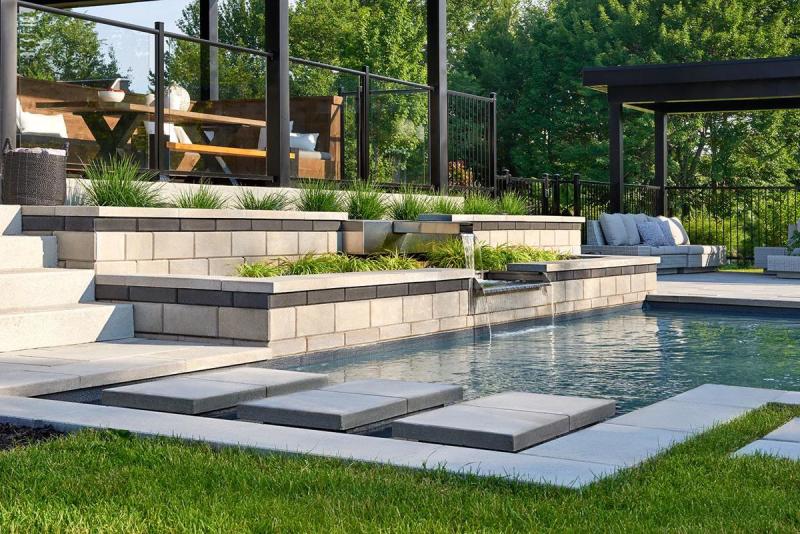
The appeal of a well-composed landscape often comes down to coherent structure: walls that guide views, define spaces, and quietly carry the load. For homeowners and designers, clean geometry and dependable performance simplify those decisions. Discover Now how refined, modular wall units can streamline everything from compact seat walls to full-scale retaining solutions without sacrificing visual detail. With a focus on material finish, proportional balance, and long-term durability, these systems fit both curated gardens and high-traffic commercial edges. When thoughtfully installed and paired with complementary surfaces, the Techo-Bloc Raffinato Smooth Wall approach merges modern aesthetics with reliable construction.
How Modular Wall Units Support Retaining, Seating, and Accent Uses
The foundation of a versatile landscape wall system is a modular format that scales up or down as needed. Modular units allow you to create a short seating edge around a fire pit, transition seamlessly to a planter surround, and step into a reinforced retaining wall along grade changes—all with a consistent visual language. Because each unit shares compatible lengths and heights, alignments remain tight and joints stay uniform, which is crucial for clean lines. That consistency makes it easier to form straight sections, graceful curves, or 90-degree turns without visual clutter. For projects that mix functions—like a courtyard that needs terracing, built-in benches, and a low accent wall—modularity keeps the build efficient and the look cohesive.
Practical layouts for multi-use spaces
A single wall palette can support multiple applications when you lean into units designed for both freestanding and retaining contexts. In a terrace, for example, a retaining section can transition into a seat-height wall that doubles as a boundary for planting beds, keeping the geometry simple and the maintenance footprint small. Where views matter, freestanding segments can frame pathways or patios as accent elements, offering a crisp edge that reduces mulch spill and defines circulation. If your plan calls for elevation changes, vary the wall heights by segment rather than switching materials; the result is a continuous aesthetic that feels purposeful rather than piecemeal. The Techo-Bloc Raffinato Smooth Wall format shines in these scenarios, supplying a uniform face and modular options that make multi-use planning intuitive.
Tips for blending uses without visual noise
- Keep unit heights consistent across adjacent features to maintain rhythm.
- Introduce step-backs for taller retaining runs; keep seat walls plumb for comfort.
- Prioritize curves or straight runs based on function: curves for gathering zones, straight lines for pathways and property boundaries.
Clean-Line Geometry for Contemporary Residential and Commercial Designs
Contemporary design thrives on clarity, and walls with precise edges and crisp jointing naturally support that aesthetic. Straight runs registered in a running bond, narrow shadow lines between units, and even reveals across corners all signal craftsmanship and intent. That kind of clean-line geometry also works in transitional spaces where architecture blends modern and traditional cues. By repeating uniform courses and keeping face textures smooth and refined, the design stays quiet—allowing plant textures, lighting, and furnishings to take the spotlight. When the same wall language continues from front entry to backyard terrace, the property reads as a unified composition.
Strategies for maintaining visual precision
Consistency begins with the base. A level, well-compacted base sets the tone for seamless courses, minimal shimming, and true corners. Dry-fitting the first few courses helps verify pattern alignment and joint spacing before committing to adhesive, a step that often pays off with straighter lines and fewer cuts. To emphasize long, uninterrupted geometry, plan terminations at logical points—like gateposts or column ends—so the eye reads intentional stops rather than abrupt breaks. On commercial sites, repeating modules along storefront plazas or courtyard edges can guide pedestrian movement and create a cohesive language across multiple tenant façades. With a refined face and uniform dimensions, the Techo-Bloc Raffinato Smooth Wall profile enables these clean, repeatable alignments.
Subtle detailing that elevates the look
- Align cap overhangs consistently; slight setbacks enhance the shadow line.
- Use mitered corners or manufactured corner units to preserve tight joints.
- Introduce linear lighting at seat-wall bases to accentuate horizontal runs after dark.
Load-Bearing Strength That Supports Multi-Level Landscape Features
Creating terraces, steps, and elevated planters demands walls that do more than look good; they must perform under lateral pressure and seasonal movement. Properly designed segmental systems use interlocking geometry, compacted base materials, and reinforced backfill to reach their load-bearing potential. As wall height increases or soils become less stable, soil reinforcement—such as geogrid placed at specified intervals—distributes forces and stabilizes the structure. The benefit of a modular system is predictability: you can design each lift and setback to meet the requirements of the site while maintaining a consistent finish. This makes it feasible to link multiple levels, integrate stairs, and tie in landings that carry foot traffic without overcomplicating the detail set.
Core engineering best practices to respect
Before construction, analyze site drainage and soil characteristics; water management is as critical as block selection for structural integrity. Install a granular leveling pad and compact in thin lifts to avoid settling, then backfill with drainage aggregate wrapped in geotextile to prevent fines migration. For taller walls or tiered landscapes, stagger wall segments with adequate spacing to reduce load transfer between levels. Always follow manufacturer guidelines and local codes regarding maximum unreinforced heights, and consult an engineer for complex or high retaining conditions. With a smooth-faced, dimensionally consistent system, stair integrations and cap transitions align cleanly, supporting both structure and appearance.
Functional features that boost performance
- Slope the grade behind walls to shed water away from the structure.
- Include perforated drain pipe at the base where required by slope and soil.
- Use adhesive on cap courses to resist uplift in high-wind or high-traffic zones.
Color Uniformity and Texture Refinement for Modern Architecture
A modern palette asks for surfaces that feel composed rather than busy. Uniform color across units minimizes visual noise, allowing the wall to read as a continuous plane rather than a patchwork of tones. A refined, smooth texture complements metal, glass, and wood elements commonly used in contemporary architecture, keeping the vocabulary consistent. When walls serve as backdrops for sculptural shrubs or outdoor art, a consistent hue and finish highlight the focal elements rather than competing with them. In residential settings, that restraint translates to calmer patios and garden rooms where light and shadow do the visual work.
Choosing tones that coordinate across spaces
Neutral grays, warm taupes, and deeper charcoals tend to pair well with both cool and warm materials, which is useful when you’re coordinating with window frames, siding, or decking. If your project includes multiple outdoor rooms, use one dominant wall color and introduce contrast through furnishings or planting; the walls remain timeless while accents can evolve. For bolder architecture, consider a darker wall tone to anchor the composition, then echo that shade in metal rails or landscape lighting. The Techo-Bloc Raffinato Smooth Wall collection is known for even coloration and a restrained, polished face, making it easier to maintain visual continuity from front entry to backyard.
Detailing to preserve a refined finish
- Keep cuts on the back or underside of caps to preserve clean visible edges.
- Plan expansion of planting beds so irrigation spray doesn’t stain wall faces.
- Use breathable, masonry-safe cleaners for occasional maintenance without etching.
Efficient Installation Through Pre-Engineered Block Dimensions
Installation speed is about more than working quickly; it’s about eliminating avoidable steps through smart planning and precise components. Pre-engineered dimensions reduce the number of cuts, simplify corner solutions, and help you maintain consistent course heights across long runs. When each unit interlocks or aligns with predictable tolerances, crews spend less time adjusting joints and more time advancing the wall. This uniformity also supports a tidy running bond and clean reveals at caps, which is critical for that modern, minimalist look. On projects with tight schedules, these efficiencies can compress timelines without compromising accuracy.
Planning layouts that minimize cutting
Start with a scaled plan that sets module counts for each segment, then confirm on site by dry-stacking the first course to verify fit. Align corners and transitions at module increments so caps land neatly and cut pieces are concealed where possible. For curves, choose radii that align with unit depth to minimize wedge cuts and keep face joints consistent. When step-downs or stair integrations occur, maintain full units at risers and use cut pieces behind the scenes. Teams that standardize these practices across sites often see measurable gains in productivity with systems like the Techo-Bloc Raffinato Smooth Wall lineup.
Workflow tips that keep crews moving
- Pre-sort pallets by unit size to reduce on-the-fly searching.
- Check level and alignment every two to three courses to avoid cumulative drift.
- Stage drainage aggregate and geotextile near the wall to streamline backfilling.
Weather-Resistant Properties That Reduce Long-Term Maintenance
Outdoor walls face a constant cycle of wetting, drying, temperature swings, and UV exposure. Durable concrete units formulated for freeze-thaw regions, with low water absorption, help prevent spalling and surface degradation over time. Dense, refined faces resist staining and contribute to easier cleaning, so the wall maintains its crisp look with minimal effort. Good detailing matters too: proper drainage behind the wall reduces hydrostatic pressure and limits moisture exposure that can drive maintenance issues. By addressing both material resilience and system design, you protect the wall’s structural performance and finish.
Building for longevity from day one
Set expectations for maintenance in the design phase. Incorporate graded surfaces and drains to keep water moving away from wall faces, and specify compatible adhesives and sealants for caps if needed. Where de-icing salts are common, use best practices that minimize direct salt contact with vertical faces, and rinse as conditions allow to reduce buildup. Seasonal checkups—verifying cap adhesion, clearing drain outlets, and inspecting for settlement—go a long way toward preserving alignment and appearance. When combined with a smooth, dense surface like that seen in the Techo-Bloc Raffinato Smooth Wall family, these measures translate into real-world durability and fewer service calls.
Practical maintenance habits
- Keep mulch and soil below cap height to avoid constant moisture contact.
- Trim irrigation heads to prevent overspray onto wall faces.
- Schedule gentle cleanings with pH-neutral cleaners to maintain surface luster.
Design Pairing Ideas for Coordinating Walls With Pavers and Slabs
Coordinating vertical and horizontal surfaces is where a project’s design voice truly emerges. Start by matching the wall’s tone and texture to nearby pavers or slabs so the space reads as a deliberate ensemble. Use the wall to frame a patio, then echo its geometry in the paving pattern—think long linear slabs aligned to the wall’s running bond. If the wall is a primary visual anchor, keep the pavement quieter; if the surface pattern is the star, let the wall recede with a simple, even hue. Discover Now how a few targeted pairings can transform a disparate set of elements into a single, polished composition.
Pairings that highlight modern lines
A smooth-faced wall couples beautifully with large-format slabs, which emphasize horizontality and make outdoor rooms feel more expansive. Consider a narrow border or soldier course that picks up the wall color, tying surfaces together without overwhelming the eye. For steps, continue the wall’s cap material across treads or choose a complementary tread that matches the slab tone; continuity in either direction will work if executed consistently. Integrate lighting beneath caps to cast a soft wash onto the paving—this accentuates the crisp junction between vertical and horizontal planes and creates nighttime depth. The Techo-Bloc Raffinato Smooth Wall aesthetic is inherently adaptable here, offering a neutral, refined face that supports a range of slab and paver styles.
Accents and details that bring cohesion
- Use metal inlays or edging that match the wall’s hardware or lighting finish.
- Repeat wall color in planter bands or outdoor furniture frames for subtle harmony.
- Align drainage grates and utility covers to the wall’s geometry to keep sightlines clean.
- Discover Now opportunities to add texture through plantings while the walls and slabs stay restrained.
